There is something strangely irresistible about being given a number.
We rate restaurants, films, hotels, Uber rides, songs, outfits, and almost everything else online. So it was probably inevitable that, sooner or later, we would start asking artificial intelligence to rate our faces too.
Upload a portrait. Wait a moment. Receive a score.
At first, it sounds like little more than internet entertainment.
But the more interesting question is not “What score did I get?”
It is:
What is an AI actually looking at when it decides how attractive a face appears?
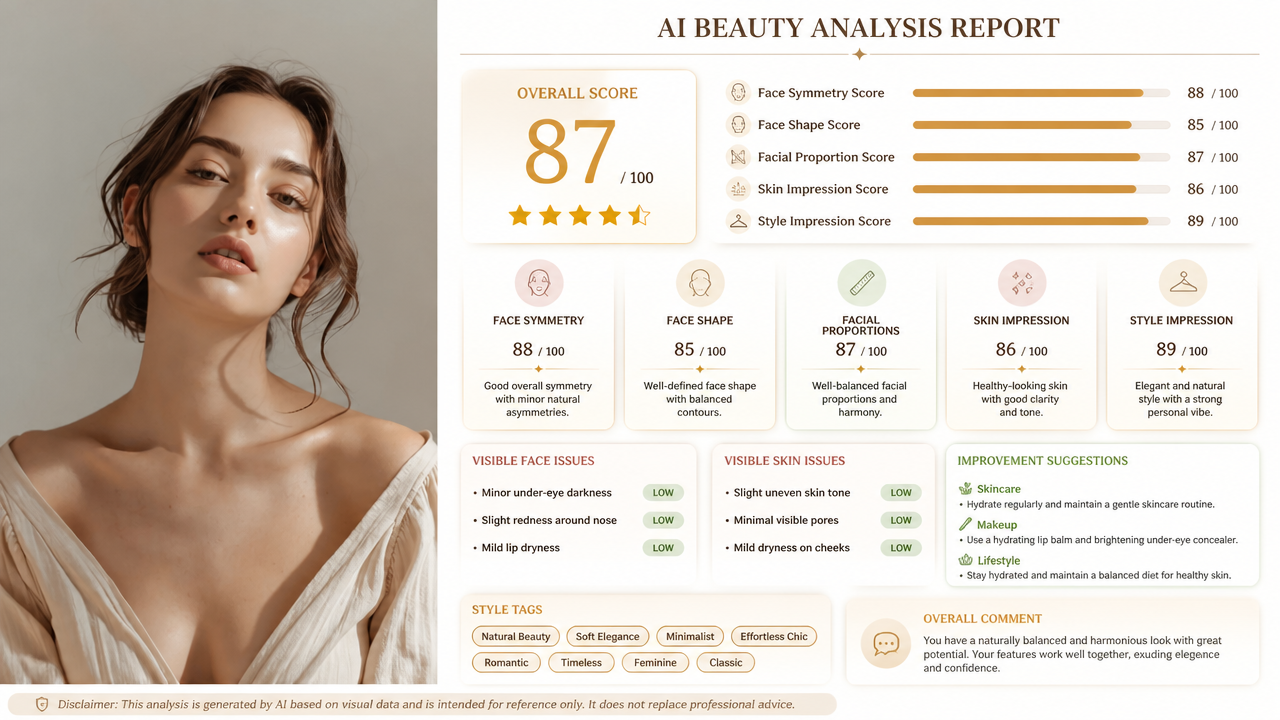
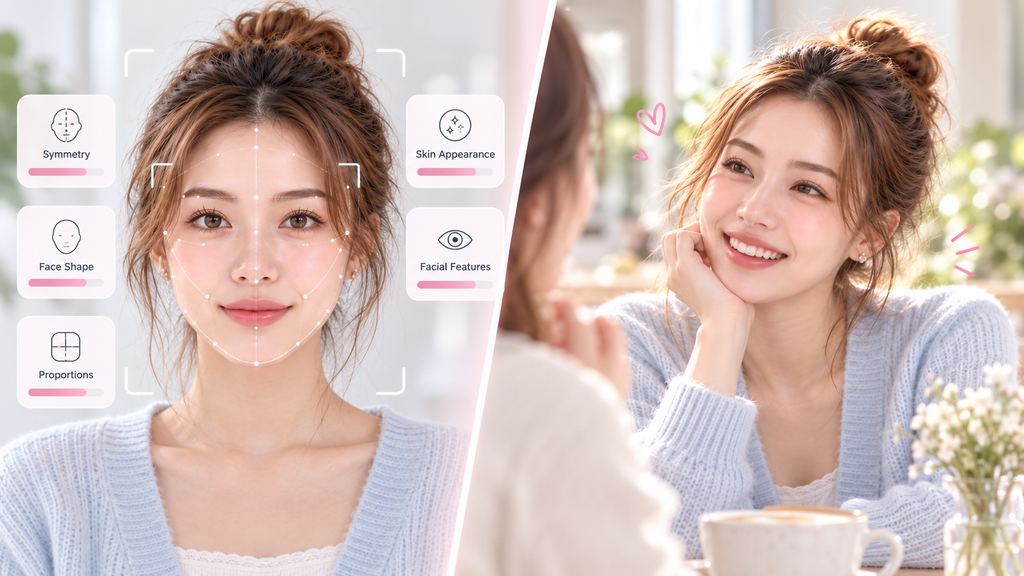
I recently tried an AI Face Rater, and what caught my attention was not the final beauty score itself. It was everything around that score: facial symmetry, proportions, face shape, skin impression, style, and the small visual details that can influence how a portrait is perceived.
That makes face-rating AI much more interesting than a simple digital beauty contest.
It also makes its limitations much more important to understand.
A Face Score Is Really a Photo Score
This is probably the most useful thing to understand before using any face-rating tool:
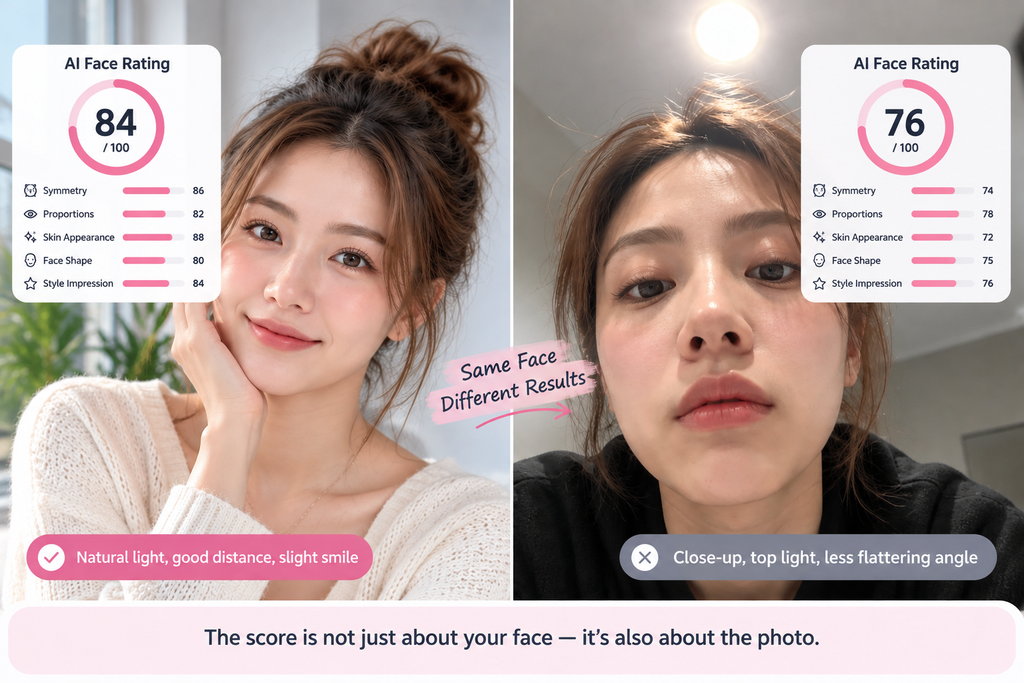
The AI is not meeting you. It is looking at one image of you.
That distinction matters.
Think about two photos taken five minutes apart.
In the first, you are standing beside a window in soft natural light. The camera is slightly above eye level, your posture is relaxed, your hair is sitting properly, and you are giving a natural expression.
In the second, the phone is too close to your face. The ceiling light creates shadows beneath your eyes. The wide-angle lens exaggerates your nose, and you happen to blink at exactly the wrong moment.
You have not become a different-looking person in five minutes.
But the photographs can look surprisingly different.
An AI system only sees the information contained inside the image it receives. Lighting, camera distance, lens distortion, expression, makeup, hairstyle, image sharpness and even the direction of your head can all affect the visual information available for analysis.
This is why I think an AI beauty score should be read as:
“How this face appears in this particular photograph under this particular set of conditions.”
Not:
“How attractive this person objectively is.”
That one change in perspective makes the whole experience more useful.
Why Does Facial Symmetry Matter So Much?
Symmetry appears repeatedly in discussions about facial attractiveness.
The basic idea is easy to understand. If the left and right sides of a face are relatively balanced, the face may appear more visually harmonious.
But real human faces are not perfectly symmetrical.
One eyebrow may sit slightly higher. One side of the jaw may be stronger. One eye may open a little wider. The corners of the mouth may behave differently when we smile.
These small differences are completely normal.
In fact, perfect computer-generated symmetry can sometimes look less natural than a real face.
So when an ai face rating tool analyses symmetry, I find it more useful to treat that information as a description of facial balance rather than a definition of beauty.
It can answer questions such as:
- Does the face appear balanced in this photo?
- Is the head slightly tilted?
- Is lighting making one side appear different from the other?
- Are certain features visually more dominant?
Those observations can be genuinely useful when choosing profile pictures, experimenting with photography or understanding why one selfie seems more flattering than another.
But symmetry is only one part of perception.
A memorable face is not necessarily a mathematically symmetrical one.
Facial Proportions Are More Complicated Than the “Golden Ratio”
Spend enough time reading about beauty online and you will eventually encounter the golden ratio.
It is often presented as if attractiveness can be reduced to a neat mathematical formula.
Measure this distance. Divide it by another distance. Compare the number with an ideal ratio.
Problem solved.
Except human beauty has never been that simple.
Facial proportions certainly influence how a face appears. The relationship between the forehead, eyes, nose, lips, jaw and overall face length changes the visual balance of a portrait.
But there is no single facial template that every attractive person follows.
Someone can have a long face and look striking.
Someone else can have a round face and look equally attractive.
Strong cheekbones work beautifully on one person. Softer contours may suit another.
What matters visually is often not whether one feature matches an imagined perfect measurement, but how the different features work together.
That is why proportional analysis becomes more interesting when it is descriptive instead of judgmental.
Rather than asking:
“Is my face mathematically perfect?”
A better question might be:
“What features visually define my face?”
That question can actually lead somewhere.
The Camera May Be Judging You More Than the AI Is
There is another reason I would never take a single face score too seriously: smartphone cameras are not neutral.
Take a selfie with the camera very close to your face and perspective distortion becomes noticeable.
Features closer to the lens can appear larger. The centre of the face may become more prominent while the sides appear narrower.
Move the camera farther away and use a longer focal length, and the same face can suddenly look different.
Lighting has an equally dramatic effect.
Light coming directly from the front can soften shadows and create a smoother appearance.
Strong light from above may exaggerate under-eye shadows.
Side lighting can make the jaw and cheekbones look more defined.
Even the height of the camera changes the impression of facial proportions.
So if you receive different scores from different photographs, it does not necessarily mean the AI is “wrong.”
It may simply be responding to different visual information.
In fact, one of the most interesting experiments you can do with a face-rating tool is to upload several normal photographs of yourself rather than searching for one definitive score.
You may discover just how much photography affects perception.
What AI Can See — and What It Cannot
AI is particularly good at analysing visible patterns.
Depending on the system, it may examine things such as facial balance, apparent proportions, face shape, skin appearance, feature placement and other characteristics present in the photograph.
AILabTools, for example, presents its result as a visual report that can include a beauty score alongside symmetry, face shape, facial proportions, skin and style impressions and improvement suggestions, while keeping the original portrait rather than turning the analysis into a beauty-filter makeover.
That is useful information.
But there is an enormous amount the photograph does not contain.
AI cannot see how expressive your face becomes when you talk.
It cannot hear your laugh.
It cannot see the way your expression changes when you are excited about something.
It knows nothing about your humour, confidence, warmth or personality.
It does not experience the familiarity that makes someone’s face increasingly attractive to the people who know them.
And these things matter enormously in real human attraction.
A static photograph freezes a person into a fraction of a second.
People do not experience each other that way.
Why the Number Feels More Important Than It Actually Is
Numbers carry psychological weight.
If an AI says your facial symmetry is 82%, that figure feels strangely authoritative.
82 sounds scientific.
It feels more convincing than someone simply saying, “Your face looks fairly symmetrical.”
But precision and truth are not the same thing.
A numerical rating is still the output of a system making an interpretation based on its design, its visual criteria and the image you uploaded.
Change the photograph and the result may change.
Change the model and the result may change again.
That does not make AI face analysis useless.
It simply means the number should be treated as a reference point rather than a verdict.
The most valuable information is often not the overall score at all.
It is the breakdown beneath it.
The Better Question: “What Can I Learn From This?”
Searching face rate ai usually begins with curiosity:
How attractive am I?
There is nothing wrong with that.
Curiosity is probably why most of us try tools like this in the first place.
But once the novelty wears off, I think there are more useful questions to ask.
Why does one photo of me work better than another?
What is my face shape?
Do certain hairstyles balance my facial proportions better?
Does changing the lighting make a noticeable difference?
Is my favourite selfie actually showing my face accurately, or is the camera angle doing most of the work?
Those questions turn a beauty score into something closer to visual self-analysis.
And that is where these tools become genuinely interesting.
You Can Use Face Analysis Without Trying to “Fix” Your Face
One part of beauty technology that makes me uncomfortable is the assumption that every observation must lead to correction.
If a system notices asymmetry, we assume symmetry must be increased.
If it identifies a round face, we search for ways to make the face appear slimmer.
If it detects a softer jawline, we begin wondering whether the jawline should be sharper.
But analysis does not have to mean correction.
Sometimes information is simply information.
Knowing your face shape might help you choose a hairstyle.
Understanding how lighting affects your skin in photographs might help you take better pictures.
Noticing that a particular camera angle changes your proportions might explain why certain selfies never look quite right.
None of those things require changing your actual face.
In some ways, that is the healthiest use of AI appearance analysis: learning how images represent us rather than teaching ourselves that our real faces need to be repaired.
Try the Same Face More Than Once
If you want to experiment with an AI face rater, I would not recommend uploading your single “best” selfie and treating the result as your final score.
Try three or four photographs instead.
Use one with natural window light.
Use another taken outdoors.
Try a neutral expression and a natural smile.
Change the camera distance slightly.
Keep filters turned off.
Then compare the results.
If your ratings move around, you have learned something important:
the score belongs partly to the photograph, not just the face.
That experiment may tell you more about AI face analysis than any single number ever could.
So, Can AI Really Tell You How Attractive You Are?
Not in the absolute way that the question suggests.
Attractiveness is influenced by facial structure, expression, grooming, cultural preferences, personal taste, familiarity and countless other factors.
AI can analyse what is visible in a photograph.
It can identify patterns.
It can describe proportions.
It can compare visual relationships.
It can turn those observations into an accessible score or report.
What it cannot do is reduce the full experience of human attraction to one universally correct number.
And perhaps that is exactly why tools like these are worth using with a little perspective.
The interesting part is not whether an algorithm gives you a 7.6, an 8.2 or something completely different.
The interesting part is understanding why the image produced that result.
Once you start looking at the lighting, symmetry, proportions, expression, framing and photographic conditions behind the number, a face-rating tool stops being simply a machine judging beauty.
It becomes a way to understand how faces — and photographs of faces — are perceived.
That is a much more useful question than asking whether an algorithm thinks you are attractive.
Because your face is not a score.
And thankfully, neither is beauty.